André Schulze: old paintings given a second life
A Dresden artist and conservator transforms forgotten paintings with pixel structures, contemporary imagery and recurring bouquet forms.
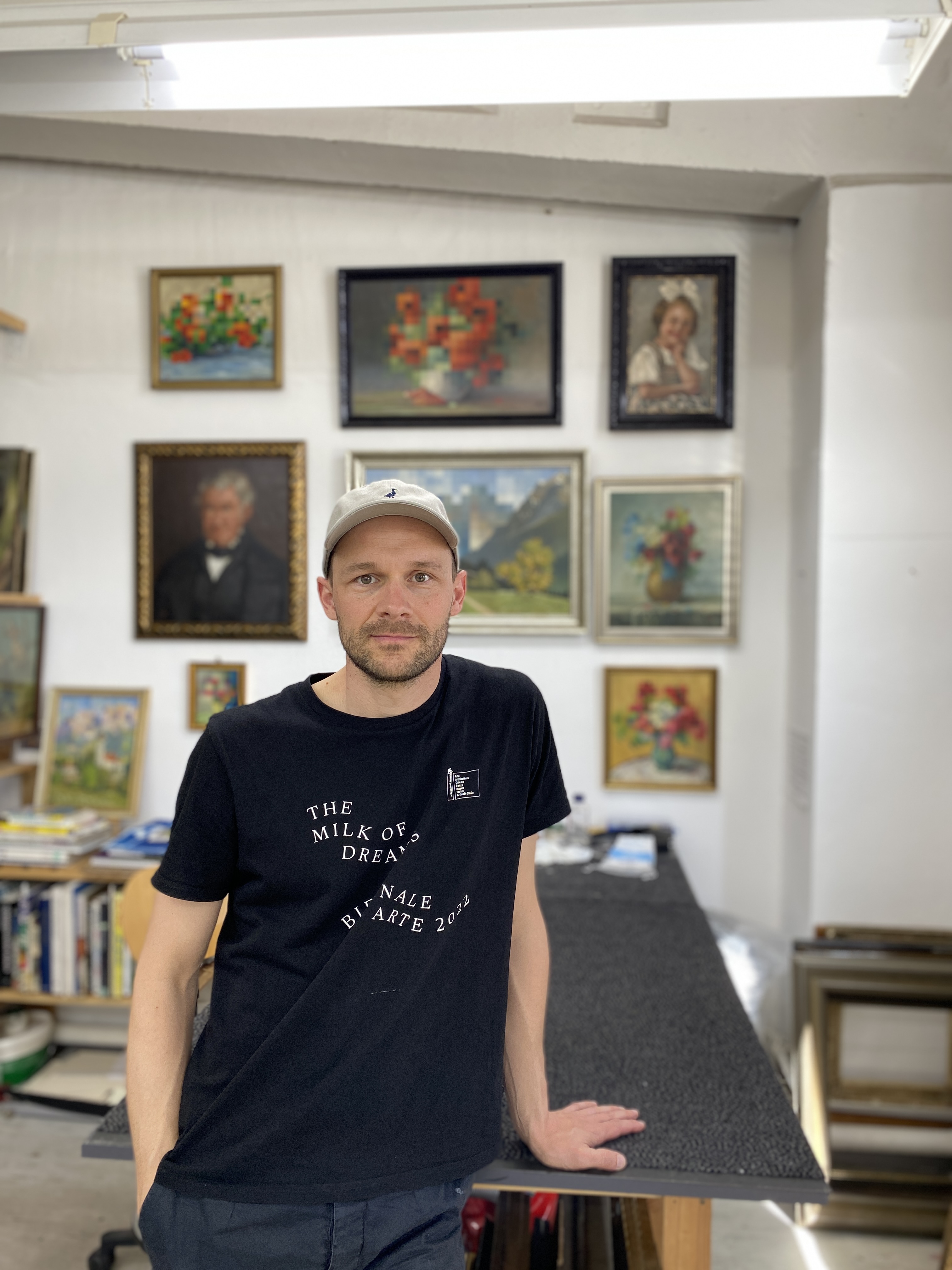
Artist at a glance
- Name
- André Schulze
- Official website
- André Schulze
André Schulze’s work begins with an ethical and visual decision: a painting judged unfashionable, damaged or disposable can remain a living object. Working from Dresden, he combines the habits of a conservator with the license of a contemporary painter. Old landscapes, portraits, devotional scenes, interiors and still lifes retain their age, craquelure and inherited atmosphere. Into them he introduces anachronistic structures—hard-edged pixels, chromatic bouquets, cartoon figures, video-game motifs and interruptions that resemble glitches or digital masks.
That collision is the core of the practice. The historical image is legible enough to assert its own period and pictorial logic, while the intervention refuses seamless restoration. Schulze lets both time layers remain visible. A mountain may be invaded by a game character; a traditional bouquet may be reconstructed as a low-poly or tiled field; a familiar old-master composition may be obscured by blocks that read simultaneously as paint, censorship and screen artifact. The result is less a joke about obsolete taste than a proposal about cultural memory: images are continuously repaired, overwritten and recirculated.
His bouquet works make the method especially clear. Across unique paintings and editions, Schulze returns to named or sourced floral compositions, translating their arrangement into crisp contemporary shapes without stripping away their material ancestry. The print program extends those motifs into screenprint and cyanotype formats, while the one-off altered paintings retain the physical history of found supports. Those formats should not be collapsed: an edition, a unique altered painting, a current gallery listing and an exhibition appearance are separate records even when they share a title family.
The artist’s training explains the surface sensitivity of the work. Conservation is an exercise in restraint, documentation and respect for a previous hand. Schulze’s visible additions are often bold, but they depend on close attention to the earlier image’s condition and composition. His stated aim of giving forgotten paintings a “second life” is more precise than a generic description such as appropriation or remix. The work is built from stewardship and intervention at once.
For collectors, the distinction between formats is central. Gallery catalogues document unique altered paintings, signed editions, screenprints and cyanotypes. Recurring titles may describe a motif family without making every object the same work. Release Radar should preserve support, finishing, dimensions, edition size and original event evidence rather than merging names. Current purchase routes and exhibition dates belong in separate modules; the artist profile should remain durable and should not imply that a current gallery collection is a complete lifetime catalogue.
Upcoming dates & buying windows
Current releases
No confirmed upcoming dates listed.
Explore the covered releases below or visit the official website.
0 archived releases
Release history & catalog
Release history is growing.
New coverage will appear here as individual releases are added.
Sources & verification
- André Schulze — official website ↗official · checked Oct 10, 2026
- André Schulze — exhibitions ↗official · checked Oct 10, 2026
- André Schulze collection ↗official · checked Oct 10, 2026
- About | André Schulze ↗official · checked Oct 11, 2026
- Kunstausstellungen Dresden | Galerie FLOX ↗official · checked Oct 11, 2026
- André Schulze entity profile revision 4 independent QA delta ↗official · checked Oct 11, 2026