Charming Baker: decorative surfaces under pressure
A guide to the British artist’s figurative practice, dark humour and deliberately unsettled surfaces.
Artist at a glance
- Born
- Hampshire, 1964
- Education
- Central Saint Martins
Profile
Charming Baker approaches polished figurative imagery as something to build and then disturb. His official biography describes a practice preoccupied with life, love, death, terror, joy and despair, and that range is useful: the work rarely settles into one emotional register. A familiar animal, a decorative surface or an apparently tender scene can carry a darker charge without becoming a simple joke. The artist’s stated use of dark humour is less a punch line than a way of keeping opposing feelings active in the same image.
Born in Hampshire in 1964, Baker studied at Central Saint Martins. He is primarily known as a painter, while also working with sculpture and editioned printmaking. Jealous Gallery’s profile emphasizes his habit of deliberately damaging some paintings. That decision matters because it resists the idea that a finished image must remain cosmetically intact. Drilled holes, cuts or other disruptions can make physical vulnerability part of the subject rather than an accident outside it.
How the imagery works
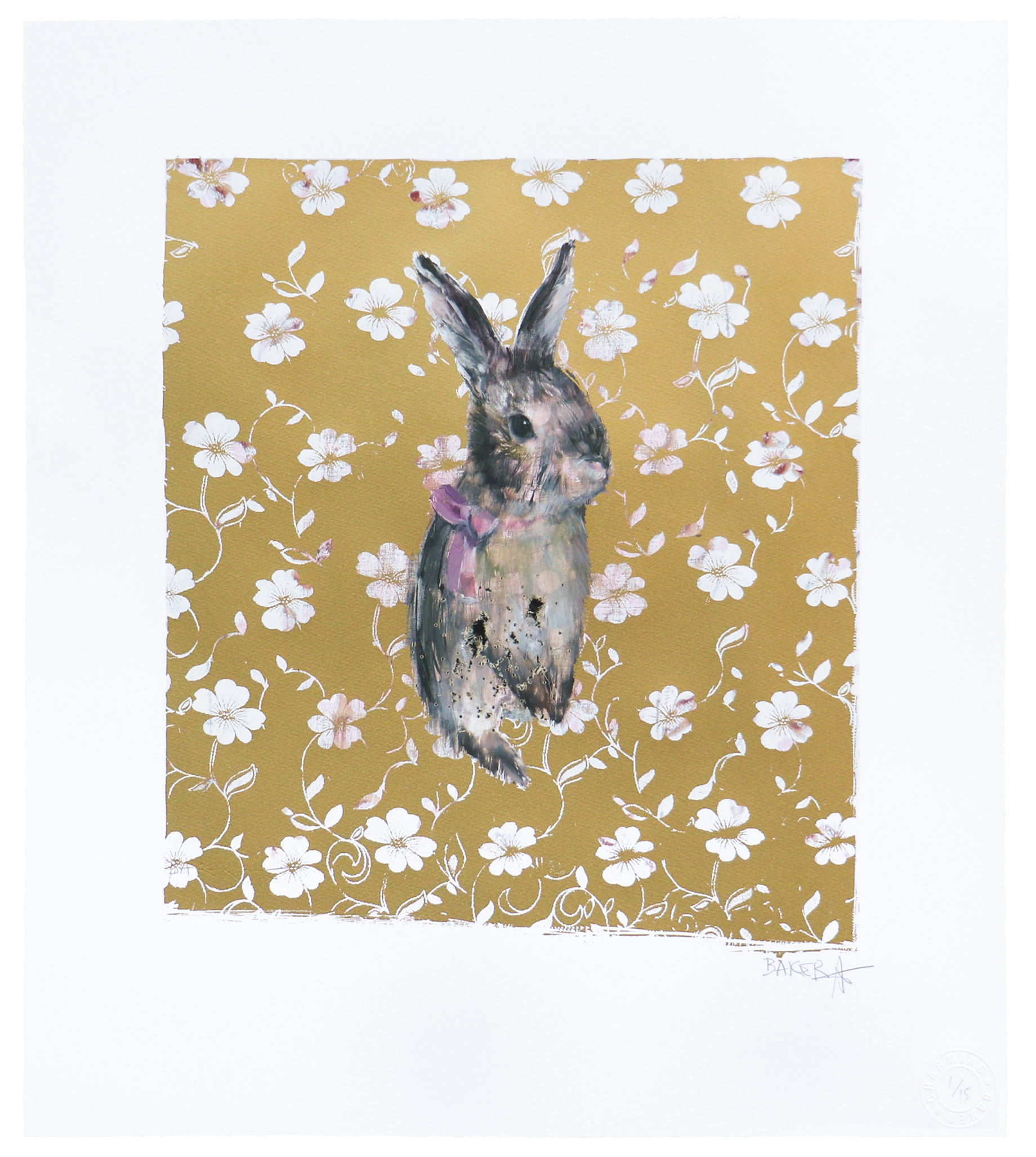
Animals appear frequently in Baker’s output, but they are not neutral illustrations. Rabbits, bears and other creatures can read as stand-ins for human anxiety, tenderness or exposure. The effect depends on the collision between an accessible silhouette and the surrounding signs of unease. In an edition such as No More Buwwetts, a rabbit is set against an ornate gold-and-white field while the title introduces a deliberately childlike mispronunciation of violence. The decorative and threatening elements do not cancel each other; each makes the other more pronounced.
That tension also explains why the work translates effectively into editions. Baker’s print releases preserve the clarity of his figures and grounds, while overlays, paper choices and finishing details give the object a material presence beyond a straightforward reproduction. Collectors should still distinguish an edition from a unique painted work and read the publisher’s exact medium, edition size and signature information rather than assuming the same process across releases.
What to watch
Baker’s titles are often part of the work’s emotional mechanism. They can redirect a seemingly straightforward image toward loss, danger or absurdity, so a release should be evaluated as a combination of title, figure, ground and physical production. Visible damage in one work should not be treated as a universal feature of every print or sculpture.
For new editions, the most useful facts are the publisher, image process, any hand-applied layer, sheet size, paper, edge treatment, edition count and whether the work is signed and numbered. Those details establish what the buyer is actually considering. Release Radar’s coverage uses official artist and publisher pages for those claims and treats current availability as a time-specific store observation, not a permanent attribute of the artwork.
Sources
Upcoming dates & buying windows
Current releases
No confirmed upcoming dates listed.
Explore the covered releases below or visit the official website.
1 archived releases
Release history & catalog

No More Buwwetts
Jealous Gallery's 2026 archival inkjet print with gold ink overlay edition, 57 × 65 cm, signed in an edition of 15.
Read the story ↗Sources & verification
- Official Charming Baker artist profile ↗official · checked Nov 22, 2026
- Exact representative artwork ↗official · checked Nov 22, 2026