Marina Abramović: performance, duration and the discipline of attention
Marina Abramović uses the body, time and audience presence to test endurance, responsibility and awareness across performance and project-derived editions.
Artist at a glance
Marina Abramović is a performance artist whose work uses the body, duration and the presence of an audience as primary materials. Her official Avant Arte biography traces that practice to Belgrade in the early 1970s, when works from the Rhythm series tested the relationship between an artist’s control and the actions of viewers.
Those early performances established questions that continue across her career: how long attention can be sustained, what happens when responsibility shifts to an audience, and whether a repeated action can become ritual. The physical extremity is visible, but it is not the whole structure. Time, stillness and the viewer’s awareness are equally important.
The body as medium and measure
In Rhythm 0 (1974), Abramović placed herself alongside objects that visitors could use, making the audience’s choices part of the work. In Rhythm 5 (1974), she entered a burning five-point star and lost consciousness. These works are often remembered for danger, yet their sharper contribution is procedural: each sets a rule, a duration and a relationship, then lets physical consequences expose the limits of that system.
That logic later expanded through long-duration performances. The Artist Is Present accompanied Abramović’s 2010 Museum of Modern Art retrospective and placed sustained, silent eye contact at the centre of the encounter. Avant Arte’s biography records more than 700 hours of performance. The action was minimal, but the changing participants made every sitting distinct.
Abramović founded the Marina Abramović Institute in 2012 to support performance, long-duration work and the Abramović Method. The institute formalized an interest that had run through her work for decades: preparing the body and attention so that seemingly ordinary actions can be experienced differently.
Energy, colour and objects
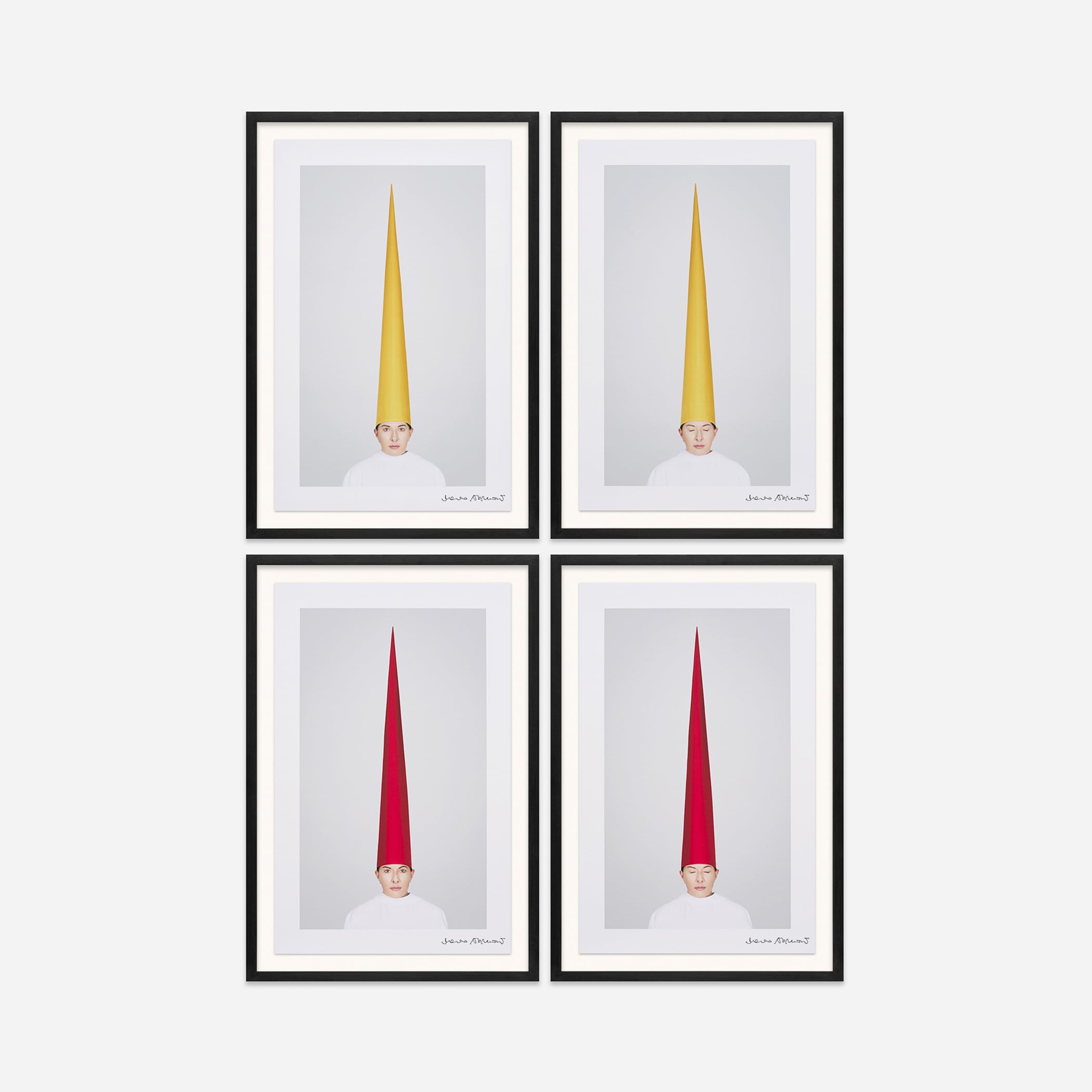
Not all of Abramović’s work remains immaterial. Objects, photographs and editions can carry evidence of a performance system without replacing the original action. The 2026 Energy Hat editions provide a precise example. They derive from Energy Clothes (2001), in which brightly coloured garments and oversized conical hats were designed to concentrate energy and heighten awareness during everyday activity.
The four prints pair yellow or red hats with eyes open or closed. This limited visual vocabulary makes attention itself legible. Open eyes establish an exchange with the viewer; closed eyes turn the pose inward. The cone extends the body upward while colour becomes an active signal rather than background decoration.
Institutional context and collector reference
Abramović received the Golden Lion for Best Artist at the 1997 Venice Biennale for Balkan Baroque. Her first European retrospective, The Cleaner, opened at Moderna Museet in 2017 and travelled to institutions across Europe. In 2023, she became the first female artist to present a major solo exhibition in the Royal Academy’s Main Galleries.
For collectors, the distinction between a performance document, an edition derived from a project and an object used in a performance is essential. A photographic print such as Energy Hat should be recorded by its exact image state, material, dimensions, edition mechanism, signature and certificate. Those facts describe the edition without collapsing it into the earlier wearable work or implying that the print itself was performed with. The connection is conceptual and documented, but the physical objects remain different.
Upcoming dates & buying windows
Current releases
Energy Hat
5:00 PM UTC · Avant Arte
0 archived releases
Release history & catalog
Release history is growing.
New coverage will appear here as individual releases are added.
Sources & verification
- Marina Abramović — Collaborations with Avant Arte ↗official · checked Nov 24, 2026