Exhibition
(he)Artwork
Mazel Galerie’s group exhibition included Martin Whatson in a presentation about immediate emotion and slower, attentive interpretation.
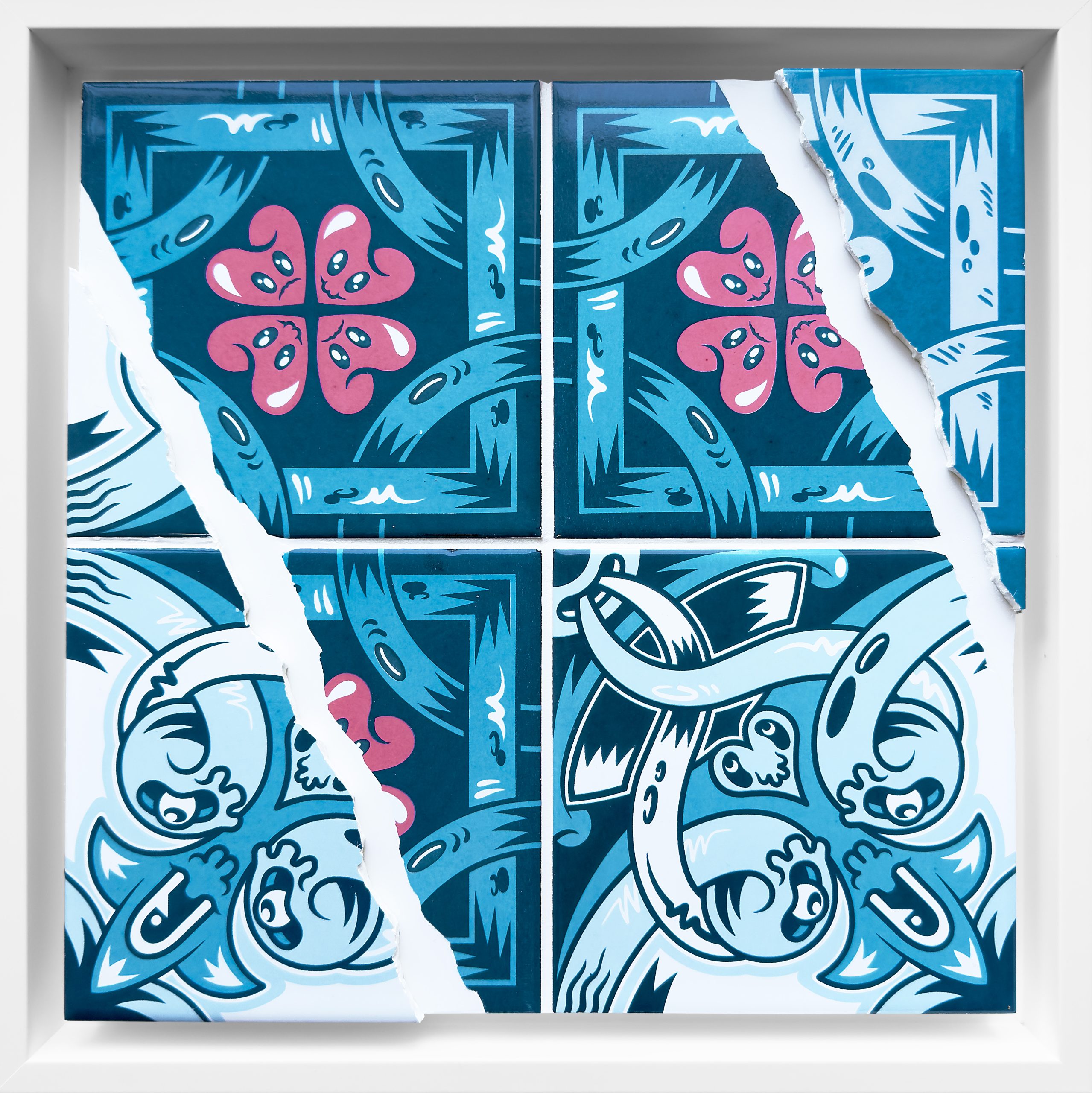
Artwork: Add Fuel. Image: Mazel Galerie; photographer not stated. · Image source
(he)Artwork brought Martin Whatson, Add Fuel and a wider group of Mazel Galerie artists together in Brussels from February 13 to March 28, 2026. The reception took place on February 12, from 6 to 9 p.m. The title joins “artwork” with “heartwork,” turning the exhibition into a proposition about how an immediate emotional response can lead to a slower, more complicated reading. Mazel’s exhibition page
The gallery describes images that work in layers: an attractive surface draws a viewer in, while further signs, references and narrative possibilities emerge through attention. Its invitation is to look past the first impact. That curatorial premise can be tested against specific objects visible in the gallery’s own exhibition photographs, rather than treated as a general claim about every participant’s intentions.
Hearts inside fractured patterns
One photographed wall holds four of Add Fuel’s blue-and-white ceramic heart compositions in a horizontal row. The two works at the right match the distinctive arrangements catalogued as Gully 40 (heart) and Gully 41 (heart). The gallery’s individual pages date both to 2026 and give dimensions of 30 × 30 cm. Their pink heart motifs immediately connect them to the exhibition’s title, but the layered construction makes that connection more than a decorative illustration. Gully 40 · Gully 41
In Gully 40, interruptions at the sides cut into the repeated tile pattern and reveal differently arranged imagery. Gully 41 uses a more insistent sequence of diagonal breaks across the square. Viewed together, the works let repetition establish a visual expectation and then disturb it. This is an interpretation of their visible construction: the gallery’s theme of looking beneath a surface finds a material counterpart in images whose layers refuse to line up seamlessly.
The other two compositions also appear in Mazel’s catalogue, but their numbers conflict across its channels: Gully 42 and 43 on the direct website correspond photographically to Gully 52 and 53 on its Artsy listings. The two Artsy listings should not be counted as two additional objects. For identifying a particular composition, the arrangement of its ceramic sections is more useful than relying on the disputed number alone. Gallery 42 Artsy 52 Gallery 43 Artsy 53
Whatson within the shared exhibition
Whatson is explicitly included in the gallery’s participant list. Mazel’s account of his practice describes a combination of figurative stencil compositions and abstract, calligraphic movement, an approach that makes the relationship between first recognition and subsequent looking relevant context for his participation. The accessible exhibition material does not identify his individual contribution, so that context should not be mistaken for a checklist attribution. Mazel’s Whatson profile

Artwork: Add Fuel. Image: Mazel Galerie; photographer not stated. · Image source
Artists
Venues & public dates
Mazel Galerie, Brussels, Belgium
Brussels, BE
Feb 13, 2026 – Mar 28, 2026
Official exhibition details ↗Sources & verification
- (he)Artwork ↗official · checked Oct 8, 2026
- (he)Artwork — verified exact exhibition image ↗official · checked Oct 9, 2026
- (he)Artwork — verified exact exhibition image ↗official · checked Oct 9, 2026
- Martin Whatson — official artist site ↗official · checked Oct 4, 2026
- MW Studio ↗official · checked Oct 4, 2026
- www.addfuel.com ↗official · checked Oct 6, 2026
- obeygiant.com ↗official · checked Oct 6, 2026