Exhibition
Gallery Art’s Post War show: colour emerges through a fractured surface
The May–June presentation paired Whatson’s Cracked variants with Paint Love and Pejac’s numbered Hope, preserving their older production dates.
Artwork © Martin Whatson. Image supplied by Gallery Art via Artsy. · Image source
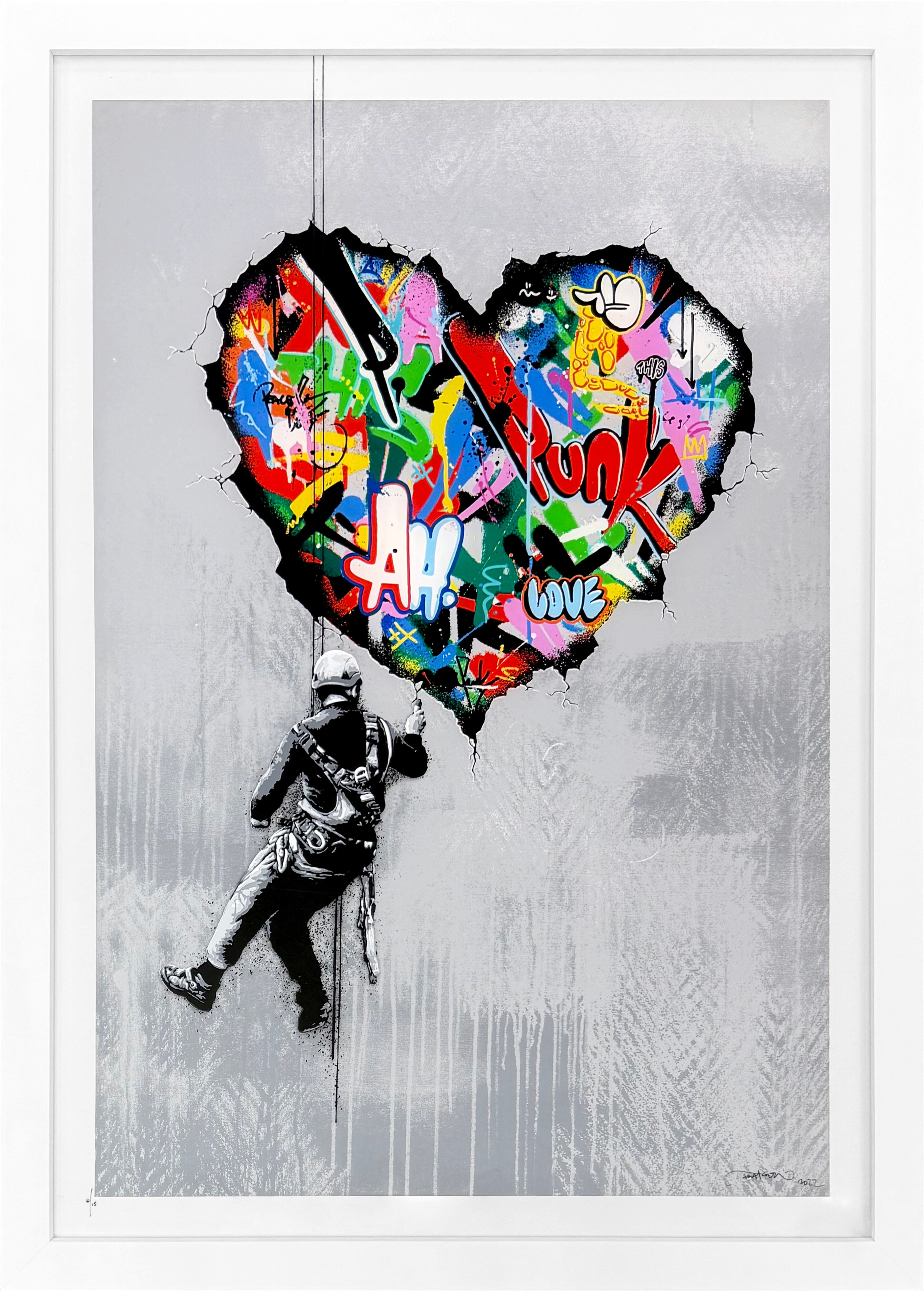
Martin Whatson’s Cracked turns a damaged-looking wall into a frame for a brilliant heart. Gallery Art included several versions of the 2022 work in its Post War & Contemporary Show, listed on Artsy from May 15 to June 28, 2026. The presentation also included Whatson’s 2020 Paint Love and Pejac’s 2024 Hope. These dates distinguish older objects in a later exhibition from newly issued 2026 releases.
Colour exposed through a grey surface
In the gallery’s photograph of the acrylic Cracked, a figure hangs from ropes below a heart-shaped opening. A helmet, harness and bent legs make the figure’s position precarious, while the larger grey field remains comparatively still. Fine cracks travel outward from the heart’s ragged black edge. Inside it, vivid marks compete for space: broad strokes, outlined lettering, drips and small graphic signs overlap.
The image makes two kinds of activity coexist. The suspended figure belongs to the restrained black, white and grey register around the opening, while the heart concentrates a much louder visual vocabulary. Colour seems to have been uncovered beneath a surface rather than simply placed on top. That impression is pictorial: the gallery identifies the work as a screenprint on acrylic, not a broken section of masonry.
Gallery Art describes this impression as a thirty-colour screenprint on 4 mm acrylic, with a 39 × 28-inch artwork area. Its listing identifies a numbered example from an edition of fifteen and records Whatson’s signature and date. The frame surrounds the complete composition in the supplied photograph; it is part of the gallery’s presentation of this object, not evidence that every version uses the same support.
Related images remain distinct objects
The show’s Whatson selection also listed a grey Cracked variant, a larger framed screenprint and Paint Love. Shared titles and imagery do not erase those differences. The acrylic support belongs to the exact listing discussed here and should not be carried across to the other two Cracked records.
Pejac’s Hope introduces another image of a fissure. Gallery Art identifies its listed example as number 723 within the thousand-part 2024 series, combining a UV pigment image with a six-colour screenprinted background and hand-applied gold leaf and ink. That work’s documented inclusion broadens the show’s encounter with altered surfaces, without implying that the gallery supplied this interpretation as a curatorial theme.
A dated presentation, with a venue discrepancy
The Artsy listing connects these works to a defined May–June period. Gallery Art’s description places the presentation at its Aventura premises. Its association with the online catalogue is documented; physical access to the named works and their installation during this period remain unconfirmed.
That boundary leaves a useful exhibition record: named works, differentiated supports and older production dates brought together in a later presentation. It does not turn the show’s opening into the first sale of any participating edition.
Artists
Venues & public dates
Gallery Art on Artsy — online presentation; physical location unconfirmed
May 15, 2026 – Jun 28, 2026
Official exhibition details ↗Sources & verification
- Gallery Art — Gallery Art Post War & Contemporary Show ↗official · checked Oct 8, 2026
- Gallery Art — exact Whatson artwork photograph ↗official · checked Oct 17, 2026
- Official artist / publisher release record ↗official · checked Oct 6, 2026
- Official artist / publisher release record ↗official · checked Oct 6, 2026
- Pejac: exhibition history on Artsy ↗independent reporting · checked Oct 8, 2026
- Pejac reference facts ↗official · checked Oct 6, 2026
- Pejac reference facts ↗official · checked Oct 6, 2026
- Pejac reference facts ↗official · checked Oct 6, 2026
- Pejac reference facts ↗official · checked Oct 6, 2026
- Martin Whatson — official artist site ↗official · checked Oct 4, 2026
- MW Studio ↗official · checked Oct 4, 2026
- Gallery Art Post War & Contemporary Show ↗official · checked Oct 10, 2026
- Mr. Brainwash — official biography ↗official · checked Oct 6, 2026
- Mr. Brainwash — The Talks ↗primary interview · checked Oct 6, 2026
- Ben Eine CV — Artsy ↗official · checked Oct 10, 2026
- Gallery Art — Ben Eine show-filter checklist ↗official · checked Oct 17, 2026
- Ben Eine — Artsy ↗official · checked Oct 10, 2026
- Ben Eine — Jealous Gallery ↗official · checked Oct 10, 2026
- OurTypes — All ↗official · checked Oct 10, 2026
- EINE ↗official · checked Oct 10, 2026
- EINE official archive ↗official · checked Oct 11, 2026