OBEY print editions: match the release, variant and offer
Compare the exact OBEY title, year, dimensions, paper, edition count and signature before treating two offers as the same print.
Match the edition first
Use the OBEY print archive to match title, year, dimensions, support, technique, edition total and signing. A standard numbered run, artist’s proof and later reissue are distinct offers. The Hendrix Fire Letterpress preview is an AP image; that image does not turn the standard run into an AP allocation.
Keep channel offers separate
An artist-store sellout does not establish every authorized channel’s stock. Power to the People was announced for both OBEY and the festival store; each needs its own availability check. For HENI collaborations such as Troubled Waters, use HENI’s format, label-signature and application terms rather than transferring OBEY’s usual screenprint details.
Keep the supporting records
Retain the exact announcement, invoice and any certificate with the work. The OBEY store FAQ says Verisart certificates apply to selected works and arrive separately; they are not retroactively issued for every older edition. A catalog match helps identify an edition but does not authenticate an unseen individual copy.
Collector context
The Hendrix example makes the distinction concrete. Fairey’s 2026 announcement links the portrait to an earlier box set. The 2014 set contains square screen prints; the later release is a standalone letterpress. A title or thumbnail alone loses that relationship. In a collection record, keep the earlier set membership separate from the later medium and year, so an image’s first appearance does not become the date of every subsequent edition.
Process terms describe how the object was made. Pace Prints’ technical guide explains that screenprinting moves ink through a stenciled mesh, while relief printing transfers ink from raised areas. These are useful distinctions when comparing a flat color image with a sheet whose printed surface also carries an impression. Treat paper, margins and edges as parts of the work’s physical identity. When asking for photographs of a particular copy, include the complete sheet and details of its marks, rather than relying only on a tightly cropped image area.
Read the edition notation before comparing two copies. The Fitzwilliam Museum defines artists’ proofs as separately numbered from the edition and often produced alongside it. An AP photograph may show the composition perfectly well, but it should remain labeled as a proof. A denominator on a numbered copy describes that edition; it does not, by itself, count every proof or every other version of the image. Neither a proof abbreviation nor a familiar signature establishes a particular copy’s ownership history.
Distribution and production credits answer different questions. For Johnny Ramone Smokin’ Strings, OBEY documented one edition divided between its store and Johnny Ramone’s store. Two sellers did not create two editions. By contrast, Welcome Visitors names Bert Green Fine Art and Aardvark Letterpress and identifies an Aardvark publishing chop. Keep these project-specific credits in your notes instead of assuming the same printer or chop for every release carrying Fairey’s name.
Sources & verification
- OBEY GIANT FAQ ↗official · checked Oct 4, 2026
- Print Archive ↗official · checked Oct 4, 2026
- Hendrix Fire Letterpress announcement ↗official · checked Oct 4, 2026
- 50 Shades of Black Box Set ↗official · checked Oct 4, 2026
- Printmaking Techniques — Pace Prints ↗official · checked Oct 4, 2026
- Artists’ proofs — Fitzwilliam Museum terminology ↗official · checked Oct 4, 2026
- Johnny Ramone Smokin’ Strings — OBEY print archive ↗official · checked Oct 4, 2026
- Welcome Visitors Letterpress — OBEY print archive ↗official · checked Oct 4, 2026
- Shepard Fairey CV ↗official · checked Oct 4, 2026
- Afrocentric (Power & Equality) — ICA Boston ↗official · checked Oct 4, 2026
- Shepard Fairey: Supply and Demand — ICA Boston ↗official · checked Oct 4, 2026
- 50 Shades of Black — exhibition article ↗official · checked Oct 4, 2026
- Shepard Fairey printing Harmony & Discord at Pace Prints ↗official · checked Oct 4, 2026
- Power to the People Festival screen-print announcement ↗official · checked Oct 4, 2026
- OBEY GIANT Terms of Use ↗official · checked Oct 4, 2026
Shepard Fairey
Explore the catalog

Shepard Fairey Siouxsie, 1978: October 9 print release
Shepard Fairey’s Siouxsie, 1978 releases October 9 at 10 a.m. PDT for US $85: signed edition of 600 on cream Speckletone.
Read the story ↗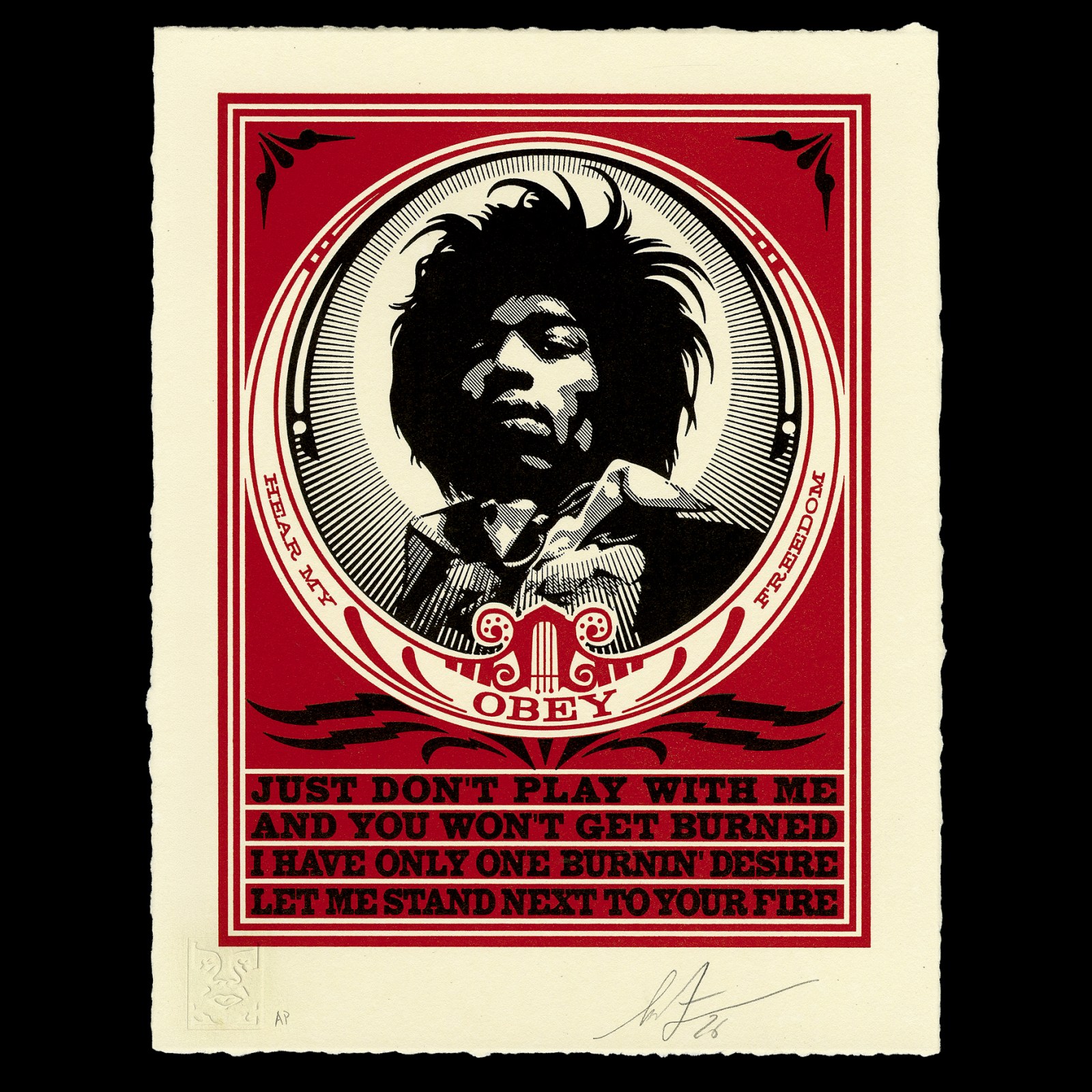
Hendrix Fire Letterpress: edition of 450, sold out
Shepard Fairey Hendrix Fire Letterpress: US $65, signed edition of 450, sold out. August 6 release; cream cotton paper and an AP-marked preview image.
Read the story ↗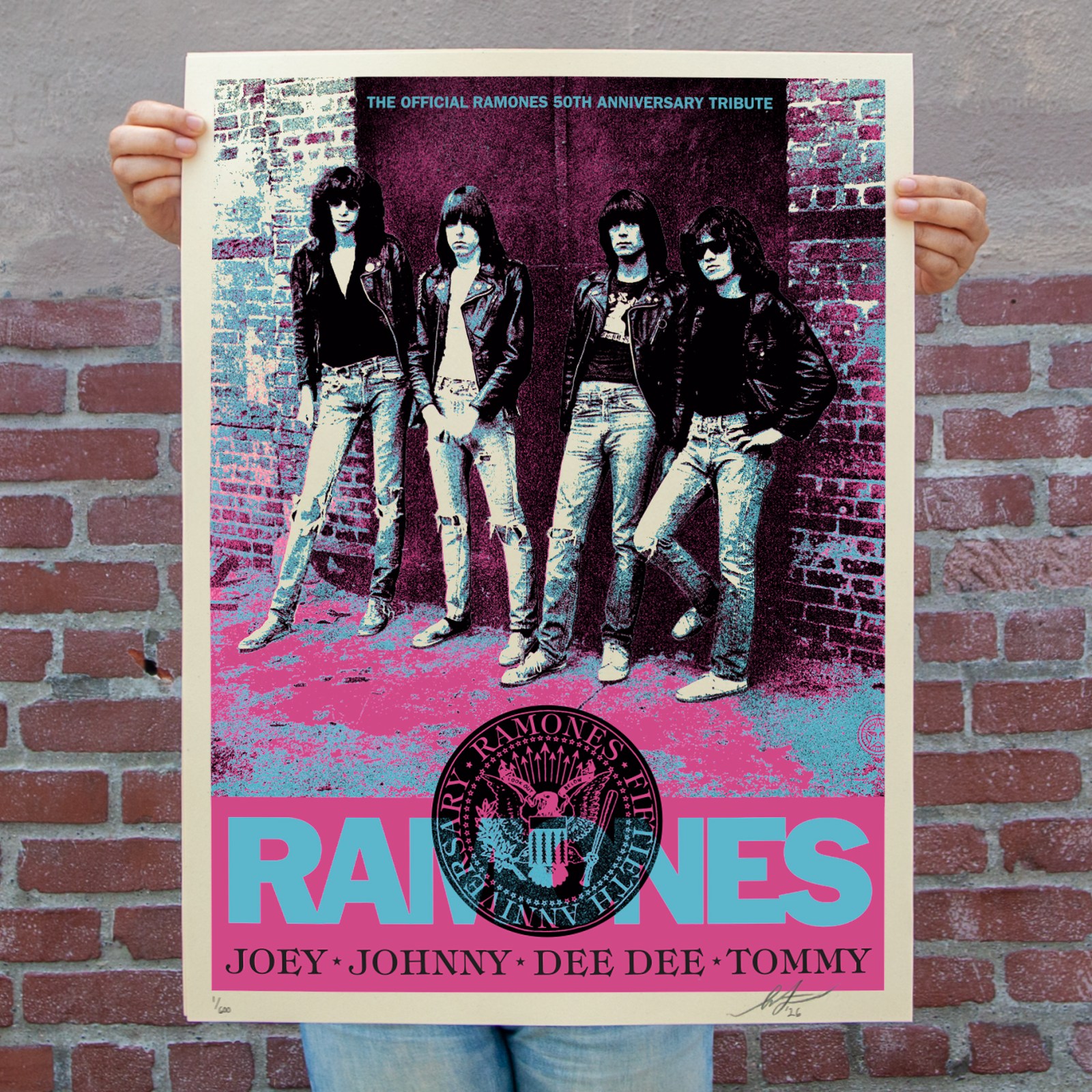
Ramones 50th: signed edition of 600, sold out
Shepard Fairey Ramones 50th: US $75, signed edition of 600, sold out at OBEY. September 3 release; 18 × 24-inch screenprint on cream Speckletone.
Read the story ↗
Power to the People Festival: print release details
Shepard Fairey Power to the People: US $70, signed edition of 500. October 1 print release via OBEY and festival store; current stock unconfirmed.
Read the story ↗